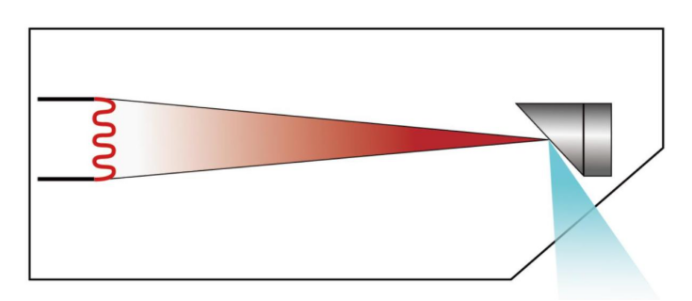

The fundamental principle of micro-focus X-ray source
It is a essential vacuum X-ray tube that generates X-rays through high-speed electron bombardment of a metal target. The key to achieving a 'micro-focus' lies in the precise control of the electron beam.
Main components
Cathode: Typically employs a hot-emission cathode (e.g., tungsten filament) or a field-emission cathode.
Focusing system: This is the core component for achieving "micro-focus". It typically consists of one or more sets of electrostatic lenses or electromagnetic lenses. Their function is analogous to that of optical lenses in converging light, precisely focusing the divergent electron beam emitted by the cathode onto an extremely small region of the anode target surface.
Anode target: The final target area bombarded by the electron beam. Typically fabricated from high atomic number metals (e.g., tungsten, molybdenum, copper). The interaction between electrons and target atoms primarily produces two types of X-rays: bremsstrahlung(continuous spectrum) and characteristic X-rays (line spectrum).
High-voltage power supply: A high voltage (typically 20kV to 225kV or even higher) is applied between the cathode and anode to accelerate electrons, enabling them to acquire sufficient energy. The voltage determines the maximum energy and penetration capability of the generated X-rays.
Cooling system: Due to the highly concentrated energy of the electron beam at a tiny point (extremely high power density), the target surface generates extremely high localized heat. An efficient cooling system (typically water-cooled or oil-circulating) is crucial to prevent target melting and ensure stable equipment operation.
Reflection target
Reflective targets are characterized by their target surface being angled relative to the incident electron beam. This design provides a larger heat dissipation volume, enabling them to handle high-voltage accelerated electrons. The key advantage of reflective targets lies in their ability to generate higher electron energy, resulting in stronger X-ray radiation. This is particularly crucial for high-energy imaging applications, such as in the automotive industry, where they are used to inspect electronic components, electronic control units, micro-mechanical devices, plugs and crimping parts, and battery boxes.
Aerospace sector: inspection of mechanical components (e.g. valves or flap brakes), circumferential electron beam (EB) welds, rotor blades, turbine blades, aircraft turbines, electronic assemblies, small titanium and aluminum castings, composite materials, etc.